What is crank stiffness?

When a cyclist attacks a climb out of the saddle or launches a sprint on a road bike, they naturally hope that every watt is directly converted into speed. One of the most important factors determining how much energy is actually transferred to the rear wheel is the stiffness of the crankset, known as “crank stiffness.” In the world of cycling, the search for the perfect balance between lightness and stiffness is an ongoing quest. Here, we explain exactly what crank stiffness is, why it is crucial for road bike performance, and which cranksets currently dominate the market.

crank stiffness

Written by: Dieter Devriendt | May 29, 2026 | Reading time: 6minutes

Learn more about the author: Dieter Devriendt


Journalist Dieter writes passionately and expertly about the world of cycling. Under the motto "we write – we ride," he gladly shares his experience with cyclists to make their lives easier, both on and off the saddle.

Key findings

  1. A rigid crankset ensures more efficient power transfer and better performance during sprints, climbs, and gear changes.
  2. The stiffness of a crankset depends mainly on the material used, its design, and the diameter of the axle.
  3. Greater stiffness improves speed and responsiveness, but can also result in higher costs, increased weight, and reduced comfort.

The stiffness of a crankset: definition

The stiffness of a crankset refers to its ability to resist deformation when a mechanical force is applied. When a cyclist pushes down on the pedals, two main types of stress attempt to deform the system: lateral stiffness and torsional stiffness.

  • Lateral stiffness: resistance to lateral bending of the cranks. When pedaling hard, the force applied is not solely vertical; the cranks are also subjected to forces pulling them toward the inside or outside of the frame.
  • Torsional stiffness: the resistance of the cranks and bottom bracket to twisting under rotational forces.

If a crankset lacks stiffness, the materials will deform under heavy load. Some of the energy generated by the muscles is then absorbed by the flexing of the aluminum or carbon fiber instead of being transferred to the chain.

Why is stiffness important on a road bike?
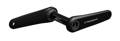
crank stiffness

On a road bike, it’s all about efficiency. The stiffer the frame, the more direct the power transfer. This is especially noticeable during high-intensity efforts.

During a final sprint, power outputs of 1,000 to 1,500 watts can be applied to the cranks. Every millimeter of flex then results in a loss of efficiency. When climbing out of the saddle, a stiff crankset also allows the bike to respond immediately to every pedal stroke, which helps maintain the pace.

A rigid crankset combined with stiff chainrings also improves shifting under load. If the chainrings bend, shifting becomes less precise and less smooth.

What factors determine stiffness?

The stiffness of a crankset is no accident; it is the result of complex engineering and materials science. The main factors are the material, the design, and the axle diameter.

The material used

Today, high-end cranksets are mainly made of aluminum or carbon fiber.

Aluminum cranksets are often forged rather than cast or machined. Forging compacts the material’s molecules more tightly, which significantly increases structural rigidity.

Carbon fiber offers engineers a great deal of design freedom. The fiber layers can be oriented in specific directions to maximize stiffness along the pedal axis while saving material in areas where stress is lower.

Form and Construction

Solid cranks aren't necessarily stiffer and are often heavier. Manufacturers therefore use hollow designs, such as Shimano's Hollowtech or the hollow carbon constructions from SRAM and Campagnolo.

By increasing the outer diameter of the cranks while keeping them hollow on the inside, stiffness is significantly increased without a significant increase in weight.

The diameter of the shaft

The axle connecting the two cranks via the bottom bracket plays a crucial role.

Traditional axles had a diameter of 24 mm (Shimano standard). Today, axles measuring 28.99 mm (SRAM DUB) or 30 mm (BB30/386EVO) are common. A thicker axle is more resistant to torsional stress and increases the overall stiffness of the crankset-bottom bracket system.

Advantages and disadvantages of high rigidity

Although maximum stiffness may seem ideal, it has both advantages and disadvantages.

The advantages

  • Maximum efficiency: nearly all of the energy produced is transferred to the transmission.
  • Immediate responsiveness: the bike feels more responsive and reacts instantly to acceleration.
  • Smoother shifting: Since the chainrings move less, the chain stays better aligned and shifts are more precise.
  • Less wear: A properly aligned chain reduces wear on the drivetrain.

The disadvantages

  • Sometimes heavier: to achieve extreme rigidity with aluminum, more material may be required.
  • Higher cost: Ultra-lightweight and highly rigid carbon cranksets require expensive manufacturing processes.
  • Less comfort: An extremely stiff drivetrain absorbs less vibration and can become tiring on long rides over rough terrain.

Three cranksets known for their stiffness

Shimano Dura-Ace FC-R9200

Shimano stays true to its aluminum philosophy with Hollowtech II technology. This crankset is made from a high-quality hollow forged aluminum alloy.

Even as many competitors switch to carbon, Shimano proves that aluminum can still offer an exceptional stiffness-to-weight ratio. The 24mm steel axle, combined with the massive cranks, provides remarkable lateral stiffness, making it a favorite among professional sprinters on the WorldTour.

SRAM Red AXS E1

SRAM takes a different approach with an all-hollow carbon construction. The Red crankset is extremely lightweight while maintaining excellent stiffness thanks to the strategic orientation of the carbon fibers.

DUB technology and its 28.99 mm axle improve torsional stiffness compared to older systems. The one-piece machined aluminum chainrings also eliminate any flex in the chainrings.

Aldhu Carbon Rotor

The Spanish manufacturer Rotor is renowned for its modular systems and innovative engineering. With the Aldhu Carbon, the brand offers a crankset specifically designed to minimize flex.

The carbon cranks, combined with a 30 mm aluminum axle, create an extremely rigid structure. The modular design also allows for the use of a one-piece spider-chainring assembly, maximizing lateral stiffness during gear changes.


Conclusion

The stiffness of a crankset is much more than just a marketing gimmick: it is the foundation of efficient power transfer on a road bike. By minimizing lateral and torsional flex, a stiff crankset ensures that every pedal stroke is fully utilized.

Although the pursuit of maximum stiffness often comes at a higher price and requires more demanding handling, the performance gains more than make up for these trade-offs for ambitious cyclists. Brands like Shimano, SRAM, and Rotor demonstrate that there are several approaches to achieving top-level performance.

For those looking for maximum efficiency and speed, investing in a stiff crankset is one of the most noticeable upgrades you can make to a road bike.

FAQ

What does the stiffness of a crankset on a road bike mean?

The stiffness of a crankset refers to its resistance to bending and twisting while pedaling. A stiffer crankset allows more power to be transferred directly to the drivetrain.

Why is a rigid crankset important?

A rigid crankset improves efficiency, acceleration, and the quality of gear shifts. During sprints and climbs, the bike responds more directly and dynamically.

What factors influence the stiffness of a crankset?

The main factors are the material used (aluminum or carbon), the design of the cranks, and the diameter of the axle. Hollow structures and wider axles generally increase stiffness.

Do you still have questions?

Contact us by email: support@upway.shop