
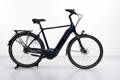
Batavus Finez E-go review: thoughtful class
The Batavus Finez belongs to the category "scientifically designed for comfort." This may sound like marketing hype, but the collaboration with TU Delft is very real: mathematical models for each frame size, measurable stability, upright position without back pain. And that's precisely where, as is often the case, the trap lies: you buy it for its comfort and ANWB ratings, but you forget to check which exact version you're choosing (Active Plus vs. Power, 400 vs. 500 Wh, and the year is decisive for the Smart System).
Written by: Jos Mans | February 12, 2026 | Reading time: 7minutes

About the author: Jos Mans
Jos is a writer and cyclist, most often both at the same time. With thousands of miles under his belt and just as many words on paper, he combines his two great passions: being on the move and telling stories.
Key findings
- The Finez earned 4 stars from the ANWB and the highest rating for "most comfortable seating position" among all e-bikes tested, but weighs between 29 and 32 kg. Stable to ride, less comfortable to carry.
- The big difference is between Active Plus (50 Nm, €2,549) and Exclusive Plus (75 Nm, Enviolo continuously variable transmission, €4,299). For urban use, the €1,750 extra is not essential.
- The Vizi lighting with V-Light (laser projection onto the road) is remarkably effective, but the motor remains audible and the kickstand can sometimes get in the way of the pedals—minor annoyances in everyday use.
What type of bike is the Batavus Finez?
Main versions
- Finez E-go Active Plus – 400 Wh, Bosch 50 Nm, Shimano Nexus 8
- Finez E-go Power – 500 Wh, Smart System (BES3)
- Finez E-go Power Exclusive – Gates belt drive, Shimano Nexus 9
- Finez E-go Power Exclusive Plus – Bosch 75 Nm, Enviolo continuously variable transmission
Frequent errors of judgment
1. Weight as an abstract number
2. Marketing autonomy vs. reality
3. Not an engine for the mountains
Specifications vs. sensations
Practical guide: how to choose the right Finez
1. The version
- Limited budget: refurbished Active Plus refurbished ~€1,900).
- Modern technology: Power Smart BES3 (€2,300–€2,700).
2. BES2 vs. BES3
3. Battery capacity
- 400 Wh: sufficient for a 10–15 km commute, 50–60 km in winter
- 500 Wh: main recommendation (70–85 km actual range)
- 625 Wh: useful only for 40+ km/day
4. refurbished checkpoints
- État batterie : <300 cycles = excellent, >500 = vérifier capacité
- Kickstand: may interfere with pedals
- Engine noise: a slight humming sound is normal, but rattling is not.
- Vizi lighting: testing laser projection
My recommendation
- regularly climb long steep hills with luggage,
- frequently carrying the bike (30+ kg),
- go on trips of more than 80 km.
- you mainly drive in the city,
- you suffer from back pain,
- Reliability takes precedence over sportiness.
- Tight budget: Active Plus refurbished.
- Best compromise: refurbished Power Smart BES3 refurbished €2,300–€2,700).
- Exclusive Plus: superb, but only for those with the budget.