How does pedal assist work on an electric bike? (pedal assist explained)

The pedal assistance is very pleasant, but sometimes it feels like you're pedaling through syrup in Eco mode. And in Tour mode, it almost feels like the seat is slipping away from under you. And why does this assistance stop at precisely 25 km/h when the motor could still deliver 250 watts?  The manual talks about "smart sensor technology" and "progressive support," but what actually happens between your pedal stroke and that push in the back? How does pedal assistance really work?

Written by: Jos Mans | February 12, 2026 | Reading time: 6minutes

About the author: Jos Mans

Jos is a writer and cyclist, most often both at the same time. With thousands of miles under his belt and just as many words on paper, he combines his two great passions: being on the move and telling stories.
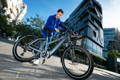
Riese & Müller e-bike

Key findings

  1. The driving experience is determined by sensors and software, not just by power in watts.
  2. The 25 km/h limit is a legal requirement, not a technical limitation.
  3. The torque (Nm) and settings say much more about the pulling force than "250 watts."

What pedal assistance does—and doesn't do

Pedal assistance means one very simple thing: the motor only helps as long as you pedal. When you stop pedaling, the assistance stops. This seems obvious, but the interpretation of this pedaling movement varies greatly depending on the system.

The chain is always the same: the sensors measure → the controller decides → the motor provides the power. The difference lies in the precision of the measurement and the way in which the decision is made.
An electric bike with pedal assistance is legally neither a moped nor a scooter. This also means: no throttle handle. In Europe, a motor can only assist if there is active pedaling and must stop at 25 km/h. Any system that operates differently falls outside the EPAC standard and is no longer legally considered a bicycle.

This explains a lot of the "strange" behavior that cyclists complain about. A bike that accelerates very quickly from a red light is doing exactly what it is supposed to do: it detects pedaling and provides assistance according to the programmed logic. A bike that suddenly stops assisting at 26 km/h is simply complying with the law.

Which sensors determine how you feel on your bike?

The biggest difference between electric bikes is not in the motor, but in how your effort is measured.

A cadence sensor records whether the pedals are turning and at what speed. As soon as it detects movement, it activates the motor according to a fixed pattern. This makes the system affordable and reliable, but also more crude. Even a slight touch of the pedals can trigger maximum assistance. When riding uphill, intense effort can sometimes feel like a leisurely ride.

A torque sensor measures the actual force you exert on the pedals. It translates your effort proportionally into motor assistance. Pedaling harder means more assistance, pedaling gently means less assistance. The feel is much more natural, especially in traffic and when climbing hills.

Modern mid-drive motors often combine several sensors at once: force, cadence, and speed. This makes them much smoother than simple hub motors equipped with only a cadence sensor. The difference is especially noticeable when starting off, changing gears, and in dense urban traffic.

Cadence sensor vs. torque sensor in practice

Here is the difference as you actually feel it on the bike:
FeaturesCadence sensorTorque sensor
What is measuredPedal movementForce exerted on the pedals
Driving feelOn/off, sometimes jerkyProportional and natural
Behavior at red lightsMay react very abruptlyProgressive and controllable
Ideal forBudget, recreational useDaily trips, coasts, cargo
Price levelLower200 to 400 € more expensive

Short version: if you want control and peace of mind, choose the pair. For occasional use, a cadence sensor may be sufficient, provided it is properly adjusted.

Why "250 watts" is misleading

Almost all electric bike brands in Europe advertise "250 watts." They have to: it's a legal requirement. But that says almost nothing about how powerful they feel.
What you actually feel is torque (Nm). This is the rotational force with which the motor assists you. A motor delivering 85 Nm will feel significantly more powerful than one delivering 75 Nm, even if both are limited to 250 watts. These differences are immediately noticeable when riding uphill, into the wind, or with a heavy load.

Added to this is the software. The controller determines how quickly and aggressively this power is delivered. Many "new generation" motors differ more in their firmware than in their hardware. That's why a refurbished electric bike with a well-tuned motor can ride just as smoothly as a new model.

Assistance modes: what has really changed?

Eco, Tour, Sport, and Turbo may seem like simple modes, but under the hood, three parameters change simultaneously: the level of assistance, the speed of power delivery, and the filtering of your pedaling.

Eco mode seems quieter because the motor kicks in less quickly and for shorter periods. Turbo mode reacts immediately and powerfully, but also consumes much more energy. The difference is not in "more watts," but in how long the motor remains active with each pedal stroke.

This is why battery life is often halved between Eco mode and Turbo mode. This is not a defect, but a software choice.

The 25 km/h speed limit explained

The assistance should gradually decrease and stop at 25 km/h. In practical terms, at around 23 km/h you will already feel less assistance, and at 25 km/h there will be no assistance at all. You can ride faster, but without assistance.

That abrupt sensation when overtaking or on a slight downhill slope is not a malfunction. It's the law. Modern systems smooth out this transition better, but the limit remains unavoidable.

Common problems (and what they mean)

An electric bike that "behaves strangely" is usually doing exactly what it was designed to do. Delayed assistance is often related to cadence thresholds. An overly violent reaction in Turbo mode is a matter of adjustment. Assistance that disappears is often due to speed detection or thermal protection, not a faulty motor.

Which sensor is best for you?

Do you ride every day to work, want peace and control, or carry luggage? Then a torque sensor is definitely worth the price. Do you mainly ride occasionally and for recreation? In that case, a good cadence sensor may be perfectly adequate.

The advantage of refurbished teething problems have been ironed out. Sensors have been tested and software updated. What remains is the character of the system—and that's a choice you make with full knowledge of the facts.

My opinion

Personally, I don't think pedal assistance should be a mystery. You need to know what you're buying. The sensors measure, the software decides, the motor executes. The difference between an enjoyable electric bike and a frustrating one lies in these settings, not in the wattage figure on paper.

Want a bike that feels like it has an extra pair of legs pedaling harder and harder with you? Choose torque. Want something simple and affordable? Cadence may be enough—and can also offer quality.

Don't be fooled by the "250 watts" rating: look at the torque, the software, and your usage. At Upway, you can make your choices with complete transparency. Tested, adjusted, and honest.

FAQ

What is the difference between pedal assistance and a throttle handle?

Pedal assistance only works when you pedal. A throttle handle provides power without pedaling and is not legally considered a bicycle in Europe.

Why does the assistance stop precisely at 25 km/h?

Because it is defined by the European EPAC standard. Above this speed, the bike becomes a speed pedelec.

Is a torque sensor always better?

For control and a natural feel, yes. For simple use, cadence may be sufficient.

Does the assistance work if I pedal very lightly?

With a cadence sensor, often yes. With a torque sensor, you get little assistance if you exert little force. This is intentional.

Can I exceed the 25 km/h speed limit?

Technically, it is possible, but legally, it is not. Above 25 km/h, the bike is no longer an EPAC and becomes subject to insurance requirements. Refurbished electric bikes offered by reliable sellers are delivered in accordance with legal standards.

Do you still have questions?

Contact us by email: support@upway.shop