
Comment choisir la bonne longueur de manivelle ?
Les cyclistes accordent beaucoup d’attention à la taille du cadre et à la hauteur de selle, mais un composant souvent négligé est la manivelle. Pourtant, cette pièce a un impact énorme sur le confort et les performances. Nous expliquons ce qu’est exactement une manivelle, pourquoi sa longueur est cruciale et comment déterminer la taille idéale pour votre morphologie et votre style de conduite.
Écrit par : Dieter Devriendt | 29/05/2026 | Temps de lecture : 6 minutes

En savoir plus sur l’auteur : Dieter Devriendt
Le journaliste Dieter écrit avec passion et expertise sur le monde du vélo. Sous la devise « we write – we ride », il partage volontiers son expérience avec les cyclistes afin de leur faciliter la vie, sur la selle comme en dehors.
Principales conclusions
- La manivelle transforme la force de vos jambes en un mouvement rotatif qui propulse le vélo.
- La bonne longueur de manivelle influence fortement les performances, la cadence, le confort ainsi que la charge exercée sur les genoux et les hanches.
- Les connaissances modernes montrent que des manivelles plus courtes sont souvent plus confortables et permettent de prévenir les blessures chez de nombreux cyclistes.
Qu’est-ce qu’une manivelle et à quoi sert-elle ?
La manivelle – également appelée « bras de pédalier » – est la pièce qui relie l’axe du pédalier (le point de rotation dans le cadre) à la pédale. Chaque vélo possède deux manivelles : une gauche et une droite, positionnées à 180 degrés l’une de l’autre. La manivelle droite est généralement reliée aux plateaux (les engrenages situés à l’avant). Avec l’axe du pédalier et les plateaux, l’ensemble forme ce qu’on appelle le « pédalier ».
La fonction de la manivelle est purement mécanique et fondamentale pour le cyclisme : elle transforme le mouvement linéaire de haut en bas des jambes en un mouvement rotatif qui entraîne la chaîne. On peut considérer la manivelle comme un levier. Lorsque vous poussez sur la pédale, le bras de la manivelle fait tourner l’axe du pédalier. Sans cet élément, il serait impossible de convertir efficacement la puissance musculaire de vos cuisses et mollets en vitesse pure sur la route ou en forêt.
L’importance de la longueur de manivelle
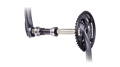
La longueur d’une manivelle se mesure en millimètres, depuis le centre exact de l’axe du pédalier jusqu’au centre exact de l’axe de la pédale. La plupart des vélos standards sont équipés de manivelles de 170 mm, 172,5 mm ou 175 mm. Bien qu’une différence de 2,5 ou 5 millimètres semble minime, elle a un impact énorme sur la biomécanique du corps pendant le pédalage.
L’influence sur les performances et la cadence
La longueur de la manivelle détermine le diamètre du cercle décrit par vos pieds lorsque vous pédalez. Une manivelle plus courte (par exemple 160 mm à 167,5 mm) crée un cercle plus petit. Cela signifie que vos pieds parcourent une distance plus courte à chaque tour. Vous pouvez ainsi maintenir plus facilement une cadence de pédalage élevée.
Comme le levier est plus court, vous devez toutefois fournir un peu plus de force pour générer le même couple, mais cela est compensé par une cadence plus rapide. Une manivelle plus courte crée également un angle de hanche plus « ouvert » au sommet du pédalage (lorsque le genou est le plus haut). Cela améliore l’aérodynamisme et la respiration, surtout sur les vélos de contre-la-montre et de triathlon.
Les manivelles plus longues (par exemple 175 mm à 180 mm) agrandissent le cercle. Cela procure un levier plus important, permettant de générer davantage de couple avec moins de force musculaire brute à basse vitesse. Cela est utile lors des montées très raides ou des accélérations depuis l’arrêt (comme en BMX ou en VTT). L’inconvénient est que les pieds doivent parcourir une plus grande distance, ce qui rend plus difficile le maintien d’une cadence très élevée. Les articulations sont également davantage sollicitées, car les genoux et les hanches doivent davantage se plier.
Confort et prévention des blessures

Une mauvaise longueur de manivelle est une cause fréquente de blessures. Si vos manivelles sont trop longues par rapport à la longueur de vos jambes, votre genou sera trop rapproché de votre poitrine au sommet du pédalage. Cela entraîne une flexion excessive du genou et de la hanche sous forte pression. Cela peut provoquer une surcharge de la rotule, des douleurs lombaires et des tensions au niveau des fléchisseurs de hanche.
Des manivelles trop courtes causent plus rarement des blessures, mais elles peuvent donner une sensation de perte de puissance ou un pédalage anormalement nerveux.
Guide étape par étape : comment déterminer la bonne longueur de manivelle ?
Choisir la bonne longueur de manivelle n’est pas une science exacte, car cela dépend de votre morphologie, de votre souplesse et de votre discipline cycliste. Avec le guide ci-dessous, vous pourrez toutefois déterminer avec précision la longueur qui vous convient le mieux.
Étape 1 : mesurez votre entrejambe
Votre taille totale en dit étonnamment peu sur la longueur idéale de manivelle ; ce qui compte vraiment, c’est la longueur de vos jambes.
Tenez-vous dos contre un mur, sans chaussures, avec les pieds écartés d’environ 15 centimètres. Placez un niveau ou un livre épais bien droit entre vos jambes et remontez-le légèrement (comme si vous étiez assis sur une selle). Demandez à quelqu’un de mesurer la distance entre le haut du niveau/livre et le sol. Cette valeur en centimètres correspond à votre longueur d’entrejambe.
Étape 2 : utilisez les règles traditionnelles comme base
Ensuite, vous pouvez utiliser votre mesure d’entrejambe dans un tableau de référence général.
- Si votre entrejambe est inférieure à 75 cm, une manivelle de 165 mm ou moins conviendra.
- Entre 75 et 80 cm : manivelle de 167,5 mm.
- Entre 80 et 85 cm : manivelle de 170 mm.
- Entre 85 et 90 cm : manivelle de 172,5 mm.
- Au-delà de 90 cm : manivelle de 175 mm ou plus.
Étape 3 : adaptez selon votre discipline et votre style de conduite
Les connaissances modernes en biomécanique (notamment issues des bike fitters professionnels) vont au-delà de la seule longueur des jambes. Votre discipline joue un rôle majeur.
Un cycliste de route grimpeur qui aime rouler en souplesse choisira de préférence la taille recommandée, voire légèrement plus courte pour favoriser une cadence élevée.
Les spécialistes du contre-la-montre et les triathlètes choisissent volontairement des manivelles de 2,5 à 5 mm plus courtes que sur leur vélo de route classique. Comme leur position est très aérodynamique, une manivelle plus courte évite que l’abdomen et la cage thoracique soient comprimés lors de la remontée du genou. Cela préserve également les muscles utilisés pour la course à pied.
Les vététistes et pratiquants de gravel bénéficient souvent d’une puissance importante à basse vitesse afin de franchir des obstacles ou des pentes abruptes. Une manivelle traditionnelle ou légèrement plus longue (par exemple 175 mm) peut alors être avantageuse, à condition de faire attention à ne pas heurter le sol ou les pierres avec les pédales.
Étape 4 : analysez votre souplesse physique
Vous souffrez rapidement du bas du dos, de hanches raides ou de douleurs aux genoux ? Dans ce cas, il est presque toujours conseillé de choisir une manivelle plus courte. Une manivelle plus courte réduit l’amplitude des mouvements des articulations. Cela signifie que vous avez besoin de moins de souplesse pour obtenir un pédalage fluide et sans douleur.
Conclusion
La longueur de manivelle est un petit détail aux conséquences majeures. Alors qu’autrefois on se contentait presque toujours des manivelles standard de 172,5 mm ou 175 mm, les recherches scientifiques modernes montrent que de nombreux cyclistes bénéficient de manivelles plus courtes. Elles optimisent l’angle des hanches, augmentent la cadence et réduisent la charge sur les articulations sensibles comme les genoux et le bas du dos.
Utilisez votre longueur d’entrejambe comme point de départ, mais tenez toujours compte de votre souplesse et de votre manière de rouler. Vous hésitez entre deux tailles ? Dans le monde du cyclisme actuel, la règle générale est souvent la suivante : en cas de doute, plus court est généralement plus sûr et plus confortable.
Pour un réglage parfait, un bike fitting dynamique chez un spécialiste reste le meilleur investissement possible.
FAQ
À quoi sert une manivelle sur un vélo ?
La manivelle relie la pédale à l’axe du pédalier et transforme la force de vos jambes en un mouvement rotatif qui entraîne la chaîne.
Comment choisir la bonne longueur de manivelle ?
La bonne longueur de manivelle dépend principalement de votre longueur d’entrejambe, mais votre souplesse, votre style de conduite et votre discipline cycliste jouent également un rôle important.
Pourquoi de nombreux cyclistes choisissent-ils des manivelles plus courtes ?
Les manivelles plus courtes permettent souvent une cadence plus élevée, un meilleur angle de hanche, davantage de confort et moins de contraintes sur les genoux et le bas du dos.