
Comment entretenir mon vélo de course ?
Beaucoup rêvent d’une carrière de cycliste professionnel. Ceux qui aspirent à devenir mécanicien, un métier pourtant essentiel dans le cyclisme, sont déjà moins nombreux. Pourtant, un entretien adéquat est crucial pour rouler de manière fluide et en toute sécurité. Nous vous présentons les principaux conseils d’entretien pour garder votre vélo de course en parfaite condition.

Écrit par : Dieter Devriendt | 23 Avril 2026 | Temps de lecture : 6 minutes

En savoir plus sur l’auteur : Dieter Devriendt
Le journaliste Dieter écrit avec passion et expertise sur le monde du vélo. Sous la devise « we write – we ride », il partage volontiers son expérience avec les cyclistes afin de leur faciliter la vie, sur la selle comme en dehors.
Principales conclusions
- Un entretien régulier rend votre vélo de course plus rapide, plus efficace et plus agréable à utiliser.
- Un bon entretien améliore la sécurité en permettant de détecter à temps l’usure et les défauts.
- En prenant soin de votre vélo, vous économisez à long terme sur les coûts des pièces.
Plus rapide, plus sûr et plus économique
Pour certains, entretenir un vélo de course est un processus presque méditatif, mais pour la plupart, c’est surtout une nécessité afin de garantir les performances et la longévité de leur machine précieuse. Un vélo bien entretenu roule non seulement plus vite et plus souplement, mais il est aussi plus sûr et vous permet d’économiser des centaines d’euros à long terme sur les pièces de rechange.
Dans cet article, nous expliquons pourquoi l’entretien du vélo est si important, quels outils et matériaux sont nécessaires, et nous passons en revue étape par étape comment garder votre vélo en parfait état.
Durabilité et économies
Un vélo de course est composé de pièces mobiles soumises à des frottements. Le sable, la poussière et la boue agissent comme du papier abrasif sur la chaîne, les pignons et les roulements. En nettoyant et en lubrifiant régulièrement, vous évitez une usure prématurée. Une nouvelle chaîne coûte quelques dizaines d’euros, tandis qu’une transmission complète usée (cassette, plateaux et chaîne) peut rapidement coûter plusieurs centaines d’euros.
Performances et efficacité
Une transmission propre est une transmission efficace. La résistance mécanique due à une chaîne sale peut vous faire perdre de précieux watts. De plus, un vélo bien réglé et propre change de vitesse rapidement et silencieusement, ce qui améliore considérablement le plaisir de rouler.
Sécurité
Lors de l’entretien, vous inspectez minutieusement votre vélo. C’est le moment idéal pour repérer une fissure naissante dans un pneu, des plaquettes de frein usées ou un boulon desserré avant que cela ne provoque une situation dangereuse, par exemple en descente.
La boîte à outils essentielle : de quoi avez-vous besoin ?
Avant de commencer, il est utile de rassembler votre matériel. Vous n’avez pas besoin d’être un mécanicien professionnel, mais disposer des bons outils rend le travail plus simple et plus efficace.
Produits de nettoyage

Un bon nettoyant pour vélo est indispensable. Il élimine la saleté sans abîmer la peinture ni les caoutchoucs. Commencez par utiliser un dégraissant pour la chaîne et la cassette afin d’éliminer les résidus gras, puis nettoyez l’ensemble du vélo avec le produit. Utilisez des brosses (douce pour le cadre, dure pour les pneus, fine pour la cassette), des chiffons en microfibres et éventuellement une peau de chamois pour sécher.
Outils et lubrification
Pour la chaîne, vous pouvez utiliser une huile ou une cire : lubrifiant sec pour conditions sèches, lubrifiant humide pour conditions pluvieuses.
Les outils essentiels comprennent un jeu de clés Allen (2 à 8 mm), une clé dynamométrique (indispensable pour les pièces en carbone), un indicateur d’usure de chaîne et une pompe avec manomètre.
Entretien hebdomadaire étape par étape
Étape 1 : nettoyage général (cadre)
Rincez le vélo à l’eau (évitez le nettoyeur haute pression). Appliquez le nettoyant, laissez agir, puis nettoyez avec une éponge ou une brosse douce. Vérifiez l’état de la peinture. Rincez doucement.
Étape 2 : nettoyage de la transmission
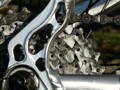
Appliquez un dégraissant sur la chaîne, la cassette et les galets de dérailleur. Brossez, puis passez un chiffon sur la chaîne jusqu’à ce qu’elle retrouve sa couleur métallique. Rincez soigneusement.
Étape 3 : séchage et inspection
Séchez complètement le vélo. Vérifiez les pneus (coupures, cailloux), les freins (usure, fuites) et l’absence de jeu dans la direction.
Étape 4 : lubrification
Appliquez le lubrifiant sur la chaîne (une goutte par maillon). Essuyez l’excédent. Ajoutez un peu d’huile sur les articulations des dérailleurs.
Étape 5 : pression des pneus
Gonflez les pneus avant chaque sortie. La pression dépend du poids et de la largeur des pneus (souvent 5,5 à 6,5 bars pour des pneus de 28 mm).
Entretien périodique
- Remplacement de la chaîne : utilisez un indicateur d’usure.
- Remplacement de la guidoline : pour l’hygiène et le contrôle du cintre.
- Contrôle des roulements : vérifiez la fluidité et les bruits.
Conseils pratiques
- Utilisez un pied d’atelier.
- Graissez légèrement les boulons lors du montage.
- Tenez un carnet d’entretien.
- Écoutez votre vélo : les bruits anormaux indiquent un problème.
Conclusion
Entretenir son vélo de course est essentiel. Cela demande un peu de temps et un investissement initial, mais les bénéfices sont considérables : un vélo toujours prêt, agréable à utiliser et durable. En prenant soin de votre vélo après chaque sortie, vous évitez les problèmes et les coûts élevés. Prenez soin de votre vélo, et il prendra soin de vous.
FAQ
À quelle fréquence dois-je entretenir mon vélo de course ?
Idéalement chaque semaine, avec un contrôle plus approfondi tous les 3 à 6 mois.
Pourquoi nettoyer la chaîne est-il si important ?
Une chaîne sale augmente l’usure et réduit les performances.
Quel est le minimum d’outils nécessaires ?
Nettoyant vélo, dégraissant, brosses, chiffons, lubrifiant, clés Allen, clé dynamométrique et pompe avec manomètre.