Internal gear hub versus derailleur


When choosing the type of gears for your electric bike, your riding style, maintenance, and motor position play a key role. Opting for an integrated gear hub means less maintenance but a more limited number of gears. Derailleurs, on the other hand, offer a wide range of gear ratios but require more maintenance and are more sensitive to external elements.


In this article, we explain why the answer to the question "which system is best for everyday use?" is unambiguously the internal gear hub.
Kalkhoff Image 5+ Advance

Written by: Dieter Devriendt | February 23, 2026 | Reading time: 6 minutes

About the author: Dieter Devriendt


A journalist specializing in cycling, Dieter writes passionately and expertly about the world of cycling. True to the motto "we write – we ride," he willingly shares his experience with cyclists to make their lives easier, both on and off the saddle.

Key findings

  1. The internal gear hub is more durable and requires little maintenance; the derailleur is lighter and more efficient.
  2. Choose the derailleur for sports and mountain biking; the hub for city riding and commuting.
  3. A hub allows you to change gears while stationary (ideal at traffic lights); a derailleur only allows you to change gears while pedaling.

A fundamental decision

The choice between an internal gear hub and a derailleur is one of the most fundamental decisions when buying a new bike. Although both systems serve the same purpose—adapting pedaling effort to the terrain—they differ radically in terms of technology, maintenance, and riding feel.

Hub with integrated gears

Kalkhoff Image 5+ Advance

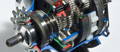
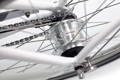
An internal gear hub is a technical feat that is virtually invisible from the outside. All the mechanics are safely housed inside the rear wheel hub.
The system operates using an epicyclic gear train: a compact set of gears that mesh together to create different gear ratios. Since the gears are internal, only a single sprocket at the rear and a single chainring at the front are visible from the outside. The chain never changes position: it remains perfectly aligned.

Recognized manufacturers of this type of system:

  • Shimano (Nexus and Alfine ranges)
  • Rohloff
  • Enviolo (continuous variation)

Advantages of the integrated gear hub

The gears are bathed in oil or hermetically sealed against dirt and water. This means you can sometimes ride for years without having to service the gear system.
The biggest advantage in the city: shifting gears while stationary. You can downshift at a red light while you are stopped.

Since the chain always remains straight, it (and the sprockets) wears much less quickly. A closed chain guard can double its service life.
In addition, a hub can be combined with a belt instead of a chain: a virtually maintenance-free and clean solution (no grease).

Disadvantages of the integrated gear hub

The system is heavier, which shifts the center of gravity backward.
 There is always a slight loss of energy due to internal friction in the gears.
In addition, the mechanism is complex: in the event of an internal failure, repairs require the intervention of a specialist.

Entry-level models generally offer a more limited range of gears than a derailleur, making them less suitable for steep slopes.

Derailleur

Kalkhoff Image 5+ Advance

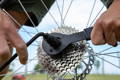
The derailleur system is the most visible and traditional, best known on road bikes and MTB. The word "derailleur" literally means "to derail," which accurately describes how it works: the chain is moved from one sprocket to another.

A bicycle equipped with a derailleur has a rear cassette consisting of several sprockets of different sizes. At the front, there are sometimes two or three chainrings.

The rear derailleur is a movable arm that maintains chain tension and moves it sideways to position it on a larger or smaller sprocket.

  • Chain on a large rear sprocket: easier pedaling (ideal for climbing hills).
  • Chain on a small rear sprocket: harder pedaling (to gain speed on flat terrain).

Advantages of the derailleur

The chain transmits power directly to the sprockets, without any complex internal mechanism. The result: maximum efficiency. Almost all of the energy applied to the pedals is transmitted to the wheel.
The system is also lighter than an integrated gear hub.

With several chainrings at the front and numerous sprockets at the rear, the gear range is very wide: very short ratios for steep climbs, very long ratios for fast descents.
Finally, with a minimum of technical knowledge, it is relatively simple to adjust or repair yourself.

Disadvantages of the derailleur

The chain and sprockets are exposed to rain, mud, and road salt: they must be cleaned and lubricated regularly.

Lateral movement of the chain accelerates wear on the transmission.

The rear derailleur protrudes from the frame, making it more vulnerable in the event of a fall or impact.

Finally, it is essential to pedal to change gears. Stopping abruptly at a red light in a high gear makes it difficult to start again.

What about for everyday use?

Going to work, shopping, taking the children to school, going for walks in a relatively flat environment: this is the reality of everyday use.

In this context, priorities change. Whereas competitive cyclists seek minimal weight and maximum performance, everyday users prioritize reliability and simplicity.

A derailleur bike parked outside in the rain or exposed to salt in winter will deteriorate quickly without regular maintenance. The hub, on the other hand, is much less sensitive to weather conditions.
When combined with a closed chain guard or belt, maintenance is limited to checking tires pressure.

In urban traffic, frequent stops are the norm. Being able to change gears while stationary is therefore a real advantage.

Conclusion: the hub with integrated gears for everyday use

Even though derailleurs remain superior in terms of sportiness, weight, and mountain capabilities, internal gear hubs are clearly the better choice for everyday use.
For most cyclists, the advantages of minimal maintenance, the ability to change gears while stationary, and long service life far outweigh the extra weight or slight loss of efficiency.

Comparison table: internal gear hub vs derailleur

FeaturesHub with integrated gearsDerailleur
TechnologyInternal planetary gear system in the rear wheelExternal sprockets (cassette) and movable arm
MaintenanceMinimal (protected internal system)High (regular cleaning and lubrication)
Change at the stopYes, ideal for city useNo, you have to pedal.
TransmissionStraight chain or maintenance-free beltAlways a chain (sideways movement)
WeightRelatively heavyLight
YieldSlight loss due to internal frictionMaximum yield
Speed rangeOften more limitedVery wide
RobustnessVery robust, protected internal mechanismMore vulnerable to shocks and dirt

FAQ

Can I change gears while stationary with any system?

No. Only a hub with integrated gears allows you to change gears while stationary. With a derailleur, you have to pedal.

Which system requires the least maintenance?

The internal gear hub is best suited if you want minimal maintenance, as the mechanics are protected from water and dirt.

Why do competitive cyclists almost always choose a derailleur?

For its lower weight, its wide range of ratios suitable for steep slopes, and its superior efficiency thanks to the absence of internal friction.

Do you have any questions?

Contact us by email: support@upway.shop