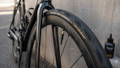
What are tires ?

On modern road bikes, tubeless is no longer a niche option. Wheel brands such as Zipp, ENVE, DT Swiss, Giant Shimano now ship their road wheels tubeless-ready as standard, while tires widths tires increased significantly: from 23 and 25 mm to 28, 30 mm, and often 32 mm on endurance models. This combination (wider rims, tires , and lower pressure) is precisely where the tubeless system truly shines.


For those considering the purchase of a refurbished road bike, this is another question to ask before buying: Is the bike equipped with a genuine tubeless system that’s been properly installed, or is the term “tubeless-ready” just a sticker on the rim? More specifically: What exactly are tires ?

Written by: Jos Mans | May 29, 2026 | Reading time: 5minutes

About the author: Jos Mans

Jos is a writer and cyclist, most often both at the same time. With thousands of miles under his belt and just as many words on paper, he combines his two great passions: being on the move and telling stories.

Orbea Orca M30

Key findings

  1. Tubeless tires offer a real advantage starting at 28 mm; with tires , the comfort gain is significantly reduced.
  2. The system works properly only if the rim, tire, rim tape, valve, and sealant are fully compatible; with hookless rims, this is even a matter of safety.
  3. The sealant dries out over time and requires regular checks; a tubeless bike left unused for several months is more likely to cause problems than to offer benefits.

tires : features

CriteriaTubelessInner tube
Small holesAutomatic sealing through preventive measuresImmediate deflation
Low-pressure pinch ("snakebite")Virtually no riskSignificant risk
Comfort at low pressureSuperiorMore limited
EditingMore complexSimpler
MaintenanceChecking and adding preventive measuresMinimal
Repair in progressWick or inner tubeReplacing the inner tube
Ideal width28 mm and largerAll sizes

How do tubeless tires work on a road bike?

A tubeless tire isn’t just a tire; it’s a system consisting of four components that must be compatible: a tubeless-ready rim, a tire , a tubeless valve with a rubber base, and a sealant inside the tire usually between 30 and 60 ml. For example, 

Continental recommends using at least 30 ml of RevoSealant per tire the initial installation of the GP5000 S TR.

The tire itself tire a seal with the rim. In the event of a small puncture, the sealant is pushed toward the leak by the escaping air, solidifies at that spot, and seals the hole—often without the cyclist even noticing during their ride. The only visible signs are sometimes a few splatters on the frame and a slight drop in tire pressure.

The key difference from a traditional tube-type system is that the tire longer just a casing, but an integral part of the pressure-retention system. That’s why a poorly installed rim strip, a leaky valve, or dried-out sealant can make the whole system unreliable.

When does going tubeless offer a real advantage?

The benefits of tubeless tires depend heavily on the tire width tire the inflation pressure used. With tires or 25-mm tires inflated to over 7 bar, the difference compared to a tube is relatively small. Starting at 28 mm, it becomes possible to ride at a lower pressure without the risk of pinching. With tires or 32-mm tires , the effect becomes clearly noticeable.

On rough surfaces—such as cobblestones, concrete slabs, cracks, or uneven pavement—this lower pressure not only improves comfort but also enhances traction. The tire better tire the unevenness of the road, the wheel bounces less, and contact with the road is more effective, especially on wet pavement.

Tubeless tires are particularly well-suited for endurance road bikes and all-road models, where tires , lower pressures, and long distances are a perfect match for the system’s strengths. They are less suitable for older road bikes with limited tires clearance tires for short urban rides.

Hooked and hookless rims and pressure limits

The choice of rim directly affects the system’s performance and safety. “Hooked” rims have an internal hook that holds the tire bead tire place. "Hookless" rims, such as Zipp's TSS (Tubeless Straight Side) models, have straight sides without a hook. They are lighter and easier to manufacture in carbon, which explains their growing popularity.

However, hookless rims impose strict pressure limits. For example, Zipp specifies a maximum pressure of 5 bar (72 psi) for its TSS road wheels and requires the use of tires approved for hookless rims. This requirement applies even when using an inner tube temporarily. Heavier riders or those wishing to use tires can quickly reach this limit. In this case, Zipp’s recommendation is clear: choose a tire rather than increasing the pressure.

It is therefore essential to verify that the tire compatible tire the rim. Just because a tire physically be mounted on a rim does not mean it is officially approved for that use.


refurbished road bikes refurbished tubeless tires: things to check

On a used or refurbished bike, the label “tubeless-ready” is not a guarantee. You should first verify that the wheel set is officially tubeless-compatible, and not simply equipped with tires . The difference is significant: mounting a tire on a rim not designed for that purpose remains a risky proposition.

Next, several items must be inspected:

  • The rim surface must be smooth, taut, and free of creases or damage.
  • The valve must have an intact rubber base and a stem that is not blocked by dried sealant.
  • The tire be inspected for cuts, damage to the sidewalls, and signs of wear.
  • The brake fluid should be checked: date added, remaining quantity, and overall condition. If in doubt, it’s best to start with a new fill.

For older bikes (particularly those from 2018 or earlier), another question arises: does the frame actually accommodate tires 28- or 30-mm tires ? Not all frames designed for 25-mm tires provide the necessary clearance.

FAQ

What exactly are tires ?

tires are road tires are mounted without an inner tube. They remain airtight thanks to a compatible rim, a special valve, and a sealant that automatically seals small punctures.

Do I absolutely have to use tubeless tires on a refurbished bike refurbished

No. A traditional tube-and-tire system is still an excellent choice, especially on older bikes or those with tires . Tubeless tires really start to make sense for tires 28 mm and wider, on rough roads, and for long rides.

How often should the brake fluid be changed?

It depends on the climate, how it is used, and the type of product. In practice, it is advisable to check it every few months and add more when the level drops or the liquid begins to solidify.

Can you install an inner tube if you have a flat tire?

Yes, as a backup solution. However, with hookless rims, the tire still be approved for that type of rim, and the pressure limits must be observed.

What is the difference between hooked and hookless rims?

Hooked rims have a hook that secures the tire. Hookless rims have a straight rim and require tires , as well as strict adherence to pressure limits, which are often set at 5 bar (72 psi) on Zipp road wheels.

Do you still have questions?

Contact us by email: support@upway.shop