Speed pedelec vs. car: how much does your commute cost?

For decades, the car has been the standard means of transportation for commuting to work. However, the popularity of speed pedelecs is growing rapidly. With pedal assistance up to 45 km/h, these fast electric bikes offer a surprisingly efficient alternative for commuters.


But beyond speed and flexibility, another factor plays an important role: cost. Is a speed pedelec really more cost-effective than a car? In this analysis, we compare the total cost of both modes of transport and examine how the bicycle mileage allowance can further accentuate the difference.

Speed pedelec vs. car

Written by: Jos Mans | March 6, 2026 | Reading time: 5minutes

Learn more about the author: Dieter Devriendt


Journalist Dieter writes passionately and expertly about the world of cycling. Under the motto "we write – we ride," he gladly shares his experience with cyclists to make their lives easier, both on and off the saddle.

Key findings

  1. The speed pedelec costs thousands of euros less per year than a car for commuting to work.
  2. Thanks to the high bicycle allowance, a speed pedelec can pay for itself and even generate a net profit.
  3. Despite a high purchase price, the payback period is generally less than two years.

How much does it cost to commute to work by speed pedelec and by car?

For the modern commuter, the daily journey to work is much more than just a trip: it is a significant expense and also an investment of time.

While the car has long been the undisputed king of commuting, the speed pedelec, an electric bike that assists up to 45 km/h, has established itself as a serious alternative.

But is switching to this "high-speed bike" also a wise choice financially?

The costs of a speed pedelec: much more than just electricity

When people see the price tag on a speed pedelec, many are surprised. A high-quality model from brands such as Stromer or Klever can easily cost between €4,000 and €10,000.

But that's only part of the story. For a daily commute of 20 to 30 km each way, there are several other costs to consider:

  • depreciation
  • interview
  • insurance and taxes
  • electricity
  • equipment

A speed pedelec loses around 60% of its value after three years. For a bike costing €7,000, this represents around €115 per month in depreciation.

Due to high speeds and intensive use, chains, brake pads, and tires faster than on a conventional bike. Professional maintenance costs between €300 and €500 per year.
Many commuters also choose comprehensive insurance against theft and damage, which costs around €200 per year.

If the speed pedelec only provides pedal assistance, standard family liability insurance is sufficient. However, if the speed pedelec can travel at speeds of over 18 km/h without pedaling, moped liability insurance is legally required. This costs between €50 and €100 per year.

The smallest expense, but not the least important, is electricity. Driving 100 km costs around €0.25 to €0.30 in electricity.

Don't forget the initial investment in equipment: an approved helmet (mandatory), rain gear, and panniers can quickly add up to around €500.
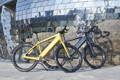
speed pedelec

The car: the silent financial drain

The costs of owning a car are often underestimated by commuters. Many expenses, such as insurance and taxes, are paid annually, while fuel is the only expense that is felt on a daily basis.

According to various estimates, the actual cost per kilometer for a mid-range car in 2025-2026 will be between €0.45 and €0.60.

For a commuter traveling 50 km per day, this includes:

  • fuel or recharge
  • depreciation
  • fixed costs
  • interview
  • possibly parking

For fuel or charging, you should expect to pay an average of €0.08 (electric) to €0.12 (gasoline) per kilometer.
The biggest part of the cost of a car remains depreciation: a new car costing €35,000 loses several thousand euros per year during the first few years.

Fixed costs (insurance, road tax, and vehicle inspection) can easily reach $1,500 per year.

Maintenance can also cost around €800 per year, depending on wear and tear and repairs.
In many workplaces, parking is no longer free, which can add $50 to $150 per month.
car

The comparison: concrete figures

For this realistic comparison, we start with a pendulum that:

  • works 220 days a year
  • travel 25 km each way (50 km per day)

Annual costs

Cost itemspeed pedelecCar (mid-size)
Depreciation€ 1 400€ 4 500
Fuel / Electricity€ 33€ 1 100
Maintenance & repairs€ 450€ 800
Insurance & taxes€ 250€ 1 200
Gross total€ 2 133€ 7 600

The difference is as clear as it is enormous: the car costs more than €5,400 more per year than a speed pedelec.

But the real game-changer for speed pedelecs remains the tax aspect.

The tax turbo: the bicycle allowance

In Belgium and the Netherlands, cycling is strongly encouraged.

  • In Belgium, the tax-free bicycle allowance often amounts to €0.35 per km (2025-2026).
  • In the Netherlands, it is generally €0.23 per km.

For our commuter (50 km/day), this represents in Belgium:

50 km × 220 days × $0.35 = $3,850 per year

This means that the speed pedelec not only pays for itself:

€3,850 in compensation – €2,133 in costs = €1,717 net gain per year.

With a car, compensation is often lower and covers only a small portion of the actual costs.

Conclusion

The speed pedelec is undoubtedly the cheapest means of transport for commuters.

While a car represents an annual expense of several thousand euros, a speed pedelec can be financially advantageous thanks to its low running costs and bicycle allowance.

For an average commute distance, the difference can exceed $7,000 per year compared to a personal car.

Even though the initial investment in a high-end bike is significant, the payback period is less than two years in most cases.

FAQ

Is a speed pedelec really cheaper than a car for commuting?

Yes. The total annual costs are several thousand euros lower than those of a mid-range car, especially for daily journeys of around 50 km.

How long does it take to recoup the cost of a speed pedelec?

In most cases, less than two years, thanks to low running costs and bicycle allowances.

What costs should be taken into account in addition to the purchase price of a speed pedelec?

You need to factor in depreciation, maintenance, insurance, electricity, and equipment such as helmets and rain gear.

Do you still have questions?

Contact us by email: support@upway.shop