Are Decathlon's road bikes worth the money?

The answer to the question of whether or not to buy a Decathlon road bike has become increasingly positive in recent years. What started out as an affordable option for casual cyclists has become a serious player in the road bike market. We’re taking a closer look at the bikes from the French sports giant—from the very affordable Triban to the sporty Van Rysel—to see if the current models are truly worth the price.

road bike

Written by: Dieter Devriendt | May 8, 2026 | Reading time: 6minutes

Learn more about the author: Dieter Devriendt


Journalist Dieter writes passionately and expertly about the world of cycling. Under the motto "we write – we ride," he gladly shares his experience with cyclists to make their lives easier, both on and off the saddle.

Key findings

  1. Decathlon has evolved from a budget-friendly sports retailer into a credible player offering high-end bicycles and competing at the WorldTour level.
  2. The distinction between Triban (comfort and entry-level) and Van Rysel (performance) has made the product lineup clearer and more competitive.
  3. Today, Decathlon offers exceptional value for money, even though the brand still suffers from lower prestige and resale value.

From supermarket bikes to high-end racing bikes

The progress Decathlon has made in recent years is impressive. Originally, the company wasn’t a bicycle manufacturer, but a sports retailer that also sold a few bicycles.

The B’Twin Era

For a long time, B’Twin was the brand that encompassed Decathlon’s entire cycling range: children’s bikes, city bikes, MTB its first serious road bikes.

In the 1990s and early 2000s, we were introduced to Decathlon’s famous blue frames. By that time, Decathlon had already made an appearance in the professional peloton. The AG2R Prévoyance team rode their bikes—often with the name “Penta” or simply “Decathlon” on the frame.

Despite these early ambitions, however, the general public continued to associate the brand with “inexpensive bikes for beginners.”

The Split: Triban – Van Rysel

Around 2018, Decathlon decided to radically change its strategy. To better meet the needs of serious cyclists, the B’Twin brand was gradually phased out of the road bike segment and replaced by two specialized brands: Triban and Van Rysel.

Triban focuses on comfort, accessibility, and beginner cyclists: “cycling for all.”
 Van Rysel, on the other hand, has become the performance-oriented brand. Its name pays homage to Decathlon’s headquarters in Lille (Rijsel in Dutch). The goal was clear: to compete with the best brands on the market.

Van Rysel in the professional peloton

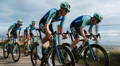
The biggest turning point for Decathlon road bikes came in 2024. The sports giant returned to the WorldTour as the title sponsor and bike supplier for the Decathlon AG2R La Mondiale team.

It wasn’t just a marketing ploy, but a true technical statement. With the introduction of the RCR Pro to the renowned Team Decathlon CMA CGM, Van Rysel proved that he was capable of building a bike that would enable the world’s best riders to win.

Ben O'Connor's victories, along with the team's aggressive racing style at the Tour de France and the Vuelta a España, have significantly boosted Decathlon's image. The perception has shifted from "cheap bikes from the sports store" to aerodynamic machines that are technically capable of competing with the world's elite.

Analysis of Current Models

Let’s take a look at what Decathlon currently offers through its two main brands.

Accessibility at Triban

Triban bikes are designed for comfort. They feature a shorter top tube and a higher head tube, which allows for a more upright riding position. This makes them ideal for beginners or anyone looking to avoid back pain.

The Triban RC 120 and RC 500 models are often equipped with Microshift or Shimano Sora groupsets and mechanical disc brakes. They fall within a price range of 500 to 850 euros, where they clearly stand out. With major brands, an entry-level bike often costs more than 1,200 euros.

The RC 500 features a reliable aluminum frame paired with a carbon fork—all for a fraction of the price.
The Triban RC 520 is probably one of the best all-around bikes for commuting and long rides. Its geometry is extremely comfortable, and it accommodates tires , making it suitable for use as a lightweight gravel bike as well.

For around 900 to 1,000 euros, you get a bike equipped with some Shimano 105 components and TRP hybrid brakes.

Performance and Speed at Van Rysel

At Van Rysel, it’s all about stiffness, weight, and aerodynamics. The geometry is more aggressive, with a lower riding position.

The Van Rysel EDR (EnDuRance) line features lightweight, responsive bikes that consistently offer exceptional value for the price. The aluminum or carbon frames are typically equipped with Shimano 105 or Ultegra groupsets and cost between €1,200 and €2,500. An excellent choice for the active cyclist who enjoys riding in the mountains.

The brand's flagship models are the Van Rysel RCR and RCR Pro: high-modulus carbon, fully integrated cables, Shimano Ultegra or Dura-Ace Di2, and aerodynamic wheels by Swiss Side or Zipp.
It’s a true rival to the bikes used by top professional teams, yet it remains much more affordable, with prices ranging from 4,000 to 9,000 euros. For competitive cyclists, it’s currently one of the best value-for-money purchases on the market.

Why buy—or why not buy?

Benefits

With Decathlon, you simply get a better groupset and better wheels for your money than with traditional brands.

Decathlon also has a massive logistics network, which means bikes are available more quickly. While some brands have waiting periods of several months, Decathlon often has larger inventories.

The lifetime warranty on aluminum frames and service centers available in nearly every major city are also major advantages.

Finally, with the RCR line, Van Rysel demonstrates that it is no longer content to simply copy other brands, but is truly innovating through wind tunnel testing and collaboration with professional cyclists.

Disadvantages

Even though resale value is improving, a Decathlon bike often holds its value less well on the secondhand market than prestigious brands like Bianchi or Colnago.

Another downside: you usually buy the bike exactly as it’s displayed in the store. Adjusting the stem length or changing the saddle at the time of purchase is often more complicated than it would be at a specialty bike shop.

Finally, in some cycling groups, there is still a certain snobbery toward bikes from "big-name brands."


Conclusion

The short answer to our main question is: "Yes, absolutely!"

Whether you’re a beginner clocking your first few miles on a Triban or an amateur cyclist looking to win the sprint on a Van Rysel RCR, Decathlon currently offers some of the best value for money in the entire cycling industry.

The days when Decathlon was just a budget option are long gone. With its entry into the WorldTour, the brand has proven that its technology is world-class.

If you're willing to set aside traditional brand snobbery, you'll get a bike that's technically superior to many much more expensive competitors.


FAQ

Is a Decathlon road bike worth the money?

Yes, Decathlon currently offers some of the best value for money on the market, with bikes that can technically compete with much more expensive brands.

What is the difference between Triban and Van Rysel?

Triban focuses on comfort and beginners, while Van Rysel targets performance, speed, and competitive cycling.

What are the drawbacks of a Decathlon bike?

They often have a lower resale value, fewer customization options at the time of purchase, and sometimes a less prestigious image.

Do you still have questions?

Contact us by email: support@upway.shop