
Testing the Gazelle Paris
The Gazelle Paris C7 clearly belongs to the category of "easy to mount, comfortable to sit on, and predictable to start." This is also its pitfall: you quickly buy it " because it's a Gazelle," and it's only later that you discover that the specific version (HMB vs. Smart, 400 vs. 500 Wh, type of brakes, display) sometimes makes all the difference between acceptable and perfectly suited.
Written by: Jos Mans | February 9, 2026 | Reading time: 6minutes

About the author: Jos Mans
Jos is a writer and cyclist, most often both at the same time. With thousands of miles under his belt and just as many words on paper, he combines his two great passions: being on the move and telling stories.
Key findings
- The Paris C7 is at its best as an urban and touring e-bike for flat terrain: stop-and-go traffic, speed bumps, cobblestones, errands.
- The main difference lies in the configuration: HMB vs. HMB Smart, 400 vs. 500 Wh, and on some older models, a different type of brakes. This should be verified for each Upway model.
- For long, steep climbs or regular heavy traction, it's not the most logical choice: the Bosch Active Line is smooth and urban in character, not a "tractor" motor.
What type of electric bike is the Gazelle Paris ?
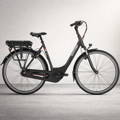
The Paris C7 is an electric city and touring bike designed for everyday ease: comfortable geometry, stable handling, and components that are especially appreciated when you just want to ride without worrying about a thing.
Gazelle emphasizes comfort and control: front suspension, tires on recent models, and a luggage rack with MIK system, allowing you to quickly change baskets, boxes, or bags.
In most cases, the motor is a Bosch Active Line (sometimes Active Line Plus, and in the Smart version, the Smart variant). This clearly defines its character: quiet, smooth, pleasant in stop-start traffic, and designed to take you around town effortlessly. Not for climbing long, steep hills with full panniers.
This is also evident in tests: an ANWB test mentions that the motor can reach its limits on long, steep climbs. In the Netherlands, this is not usually a problem, but it is better to know this in advance.
Important point: the Paris C7 does not come in a single fixed configuration. There are three versions in total:
- Paris C7 HMB (classic Bosch system)
- Paris C7 HMB Smart (Bosch Smart System, often with a more modern display such as the Purion 200)
- Paris C7+ (more comfort and adjustment options; in recent communications, Gazelle mentions increased comfort compared to the C7)
Where many people go wrong
The most common misconception about this type of bike is that a belt or integrated gear hub automatically means you can ride anywhere effortlessly. The real difference becomes apparent after a week of rain, two weeks of wind, and journeys filled with stops and starts.
1. Autonomy as an absolute figure
We see 400 Wh or 500 Wh and think, "400 will be enough." Sometimes it is.But the difference isn't just measured in kilometers, it's measured in peace of mind: how much margin is left when it's cold, when you're constantly riding into a headwind, or when you're riding in high assist mode because you just want to get there on time? For example, a test may indicate 72 km at maximum assistance, while retailers talk about much wider ranges. The reality is that it varies. Always compare with your own conditions (terrain, weather, frequency of stops).
2. Obstacles: "It'll be fine"
Gazelle mentions hydraulic disc brakes on the C7, but on some older versions you can still find other types of brakes (rim brakes). This is not a minor detail. In the rain, with a loaded rack, you want to know exactly what you have at your fingertips. A rim brake behaves very differently (less consistently) than a disc brake.
3. Climbs, bridges, and load
The Paris C7 handles bridges, viaducts, and slightly hilly terrain very well. But long, steep climbs with a heavy load are another matter entirely. The Active Line motor is designed for smooth urban use. Buying this bike with the idea of "I'm going to ride in the mountains with full panniers" often leads to disappointment.
Specifications vs. driving feel
Let's be honest: you don't buy a Paris C7 for its specs, and you don't usually attach undue importance to them. You buy it for three things in everyday driving: stability, predictability, and low maintenance.
The Shimano Nexus 7 hub is a good example. On paper, it has "only" 7 speeds. In the city, this is ideal: controlled gear shifting, even when stopped at an intersection, and a system that is less sensitive to dirt than an open derailleur.
Add a chain guard to that, and you get something that many people underestimate: a bike that remains enjoyable even after a wet week.
The weight is also a good reminder of reality. According to tests and dealer data, we see figures between 22.6 kg and 25.2 kg, depending on the model year, battery, and frame. Translation: this is not a lightweight bike, but a stable and comfortable adult city bike. Riding it is enjoyable. Carrying it is feasible, but not really pleasant. This is also why the choice between 400 and 500 Wh is practical: more battery = more weight, but also less stress when it comes to recharging.
The HMB Smart version adds an extra layer: the Bosch Smart System and a more modern display. This can be nice (controls, functions, integration), but it also means more electronics. With refurbished, it is therefore essential to check that everything is working properly and that the system is up to date. The Smart is only really enjoyable if it is also stable.
Practical guide: choosing the right Paris C7
If you're looking for a Paris C7 on Upway, always note these three points before falling in love with the photo:
1. Exact name of the version
Check whether it is a C7 HMB, C7 HMB Smart, or C7+. This avoids a lot of confusion.
2. Battery capacity
- 400 Wh: often sufficient for short to medium urban journeys, especially if you can easily recharge at home.
- 500 Wh: more logical if you ride all year round, often have headwinds, or simply want more leeway (fewer recharges, less stress).
3. Brake type and comfort
Check the type of brakes. Rim brakes are still found on some 2021 models, while newer models are increasingly equipped with disc brakes. Also look at the width of tires comfort features (suspension fork; on the C7+, comfort is further enhanced).
And for a refurbished bike, also consider:
- Battery status: not just capacity in Wh, but actual health.
- Brakes: pads, discs, or rims, and above all, progressiveness and feel.
- Transmission: chain/crankcase, sprockets, Nexus hub, which must shift gears smoothly.
- MIK luggage rack: no play or deformation, as it is used daily.
My recommendation
If you ask me where the Gazelle Paris really excels, it's on daily urban journeys of 10 to 20 km. Upright position, stability, predictable handling. Not exciting, but very pleasant. I recommend it especially for people who ride in towns or villages, with lots of stops, speed bumps, damaged roads, and a basket or pannier at the rear. In this context, comfort pays off every day.
Between 400 and 500 Wh, I would always choose 500 Wh for peace of mind. And between HMB and Smart: Smart is interesting if you actually use the modern features of the screen and ecosystem, but it remains an additional system, with potentially a little more complexity.
And above all: don't buy this bike if you dream of riding in the mountains. Buy it as a city bike and for leisurely rides. That's where it excels.
FAQ
What is the difference between Paris C7 HMB and Paris C7 HMB Smart?
The Smart version uses the Bosch Smart System (often with a more modern display such as the Purion 200). It offers additional features and more up-to-date controls. The basic characteristics (comfort, urban use) remain similar, but you add electronics: when buying refurbished, always check the stability of the system.
Is the Gazelle Paris suitable for hills?
For bridges, viaducts, and slightly hilly terrain: yes. For long, steep climbs with a load: less logical. Tests indicate that the motor can reach its limits, which corresponds to its urban orientation.
What is the battery life with 400 or 500 Wh?
Think of it like a beach. On flat terrain, 400 Wh may be enough for many trips, but cold weather, wind, weight, and a high level of assistance reduce range. 500 Wh offers more leeway and less dependence on "it has to happen today."
Do all Paris C7s have hydraulic disc brakes?
Not necessarily. Recent versions feature them, but some older models may be different. That's why it's important to check each Upway model Upway the type of brakes has a significant impact on control and confidence, especially in the rain.
refurbished a good choice for the Paris C7?
Often yes, precisely because it's an everyday bike. The advantage lies in its reliable base: battery checked, brakes and wear parts inspected, adjustments made. This is ideal for buyers who are looking above all for peace of mind and reliability, rather than the latest gadgets.