
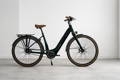
Testing the Granville E-Elegance electric bike
If you type " Granville E-Elegance" into Google, you will quickly come across models and technical specifications that sometimes differ significantly. This is not usually an error on the part of the websites, but rather the result of the fact that there are several versions and several model years under the same name. And this is precisely where disappointment arises: you think you are buying an E-Elegance with a belt drive and "quiet" hub, and you end up with a derailleur version. Or vice versa: you expect a 750 Wh battery and discover a 625 Wh version.
In this test, I deliberately take a practical approach. I review the four most common versions of the E-Elegance—RD, NEX, NEX Belt, and Enviolo Belt—and explain how they differ in real-world use. Equally important: the motor/battery checkpoints for each version and how to choose without regret.
Written by: Jos Mans | January 26, 2025 | Reading time: 5minutes

About the author: Jos Mans
Jos is a writer and cyclist, most often both at the same time. With thousands of miles under his belt and just as many words on paper, he combines his two great passions: being on the move and telling stories.
Key findings
- The choice depends primarily on the drivetrain: RD (derailleur), NEX (hub), NEX Belt (hub + belt), or Enviolo Belt (continuous variation + belt).
- The battery and motor may vary depending on the version and year of production (notably, there are 625 and 750 Wh models, as well as different Bosch lines and different displays). Therefore, always check the specific listing, not just the model name.
- This type of bike is often sturdy and rather heavy. This is an advantage on the road (stability), but less convenient if you often have to carry it or maneuver it in a narrow space.
Granville: brief history and positioning
The four versions of the E-Elegance explained
1. E-Elegance RD (rear derailleur)
2. E-Elegance NEX (hub)
3. E-Elegance NEX Belt (hub + belt)
4. E-Elegance Enviolo Belt (continuous variation + belt)
Engine and battery: what to check in every ad
- Up to about 25 km per day, with the option of recharging at home or at work: 625 Wh is more than enough.
- For journeys of 35 to 60 km per day, all year round, in windy and cold conditions and with a load (panniers, child): the 750 Wh version is more reassuring.
Driving experience and daily maintenance
- RD: wide range of ratios, but no more conventional wear points.
- NEX: minimal constraints on use.
- NEX Belt: the simplicity of NEX, with even less maintenance thanks to the belt.
- Enviolo Belt: maximum peace of mind in the city and in stop-and-go traffic, if you like trapless shifting.
Help with practical choices (especially refurbished items)
- The exact version: RD / NEX / NEX Belt / Enviolo Belt.
- Battery capacity in Wh: 625 or 750 (or other, but this must be clearly indicated).
- The motor line and display: take note of these to avoid disappointment.
- Weight and storage: carrying, stairs, narrow rooms? Things to consider.
- The points of contact: saddle and handles. This may seem secondary, but after 40 minutes, it is often decisive.
- Battery test and actual capacity (ideally quantified)
- condition of brakes and tires
- condition of the transmission (belt/chain/hub)
- Bosch software diagnostics and control
My recommendation
- You want maximum smoothness and love trapless: Enviolo Belt.
- Looking for a wider gear range and a classic feel: RD.
- You want the simplest and most robust solution possible: NEX.