
Koga Miyata: Is an old Koga still a good deal?
Koga Miyata isn't just a bike—it's an era. The Dutch manufacturer Koga collaborated with the Japanese company Miyata for many years, until the partnership ended in 2010. Everything that has rolled off the production line since then has simply been called KOGA.
For a buyer, the name therefore matters less than one might hope. The real question isn't whether Koga is a good brand, but whether this specific model is still a sensible purchase.

Jos Mans
Written by: Jos Mans | Published on: September 29, 2026 | 11-minute read
In a nutshell
- Koga Miyata refers to a group of brands from a bygone era, not a specific bicycle or a single standard of quality.
- Koga's reputation is based on its frame construction, geometry, and finish. On an electric Koga, it is the battery, the motor, and the availability of parts that determine its practical value.
- A newer electric bike from a less prestigious brand may be a better technical choice than an older high-end model with a worn-out battery.
- Always ask for the exact model, year, engine type, and measured battery capacity before discussing price.
One name, dozens of bikes
Yet this dual name continues to appear in ads, on classifieds websites, and in online searches, as if it referred to a single, easily recognizable model. That is not the case. Behind it lie dozens of models spanning dozens of model years, ranging from steel touring bikes to modern belt-driven e-bikes.
The difference between the brand's historical period and its current period determines what you should look for in a used model.
| Criteria | The History of Koga Miyata | Current KOGA |
|---|---|---|
| Period | Especially before 2010 | Starting in 2010, under the name KOGA |
| Positioning | A sports brand focused on hiking | High-end city, sports, and touring bikes |
| Highlights | Frame Construction, Finish, Geometry | Finish, choice of components, integrated technology |
| Main Risk | Outdated e-bike electronics | Battery degradation and expensive built-in components |
| Key Question to Ask When Buying | What condition are the frame and components in? | Is this complete bike right for your needs? |
| Spare Parts | Depending on the system, they can sometimes be hard to find | Generally easier to obtain |
What Koga Miyata Is—and What It Isn't
The collaboration between Koga and Miyata spanned decades and gave rise to bicycles that still enjoy a solid reputation today: meticulously crafted frames, well-thought-out geometry, and a finish that didn’t chip after two winters. This reputation is well-deserved. However, it pertains to the frames and to a time when the bicycle was a purely mechanical product.
An electric Koga is a whole different story. It includes a battery, a motor, a display, wiring, and software. These components age at their own pace—significantly faster than an aluminum frame. A bike from 2015 might have a frame that’s still good for another fifteen years and a battery that will give out in two years.
In my opinion, this is where the biggest fallacy lies among those looking for “a Koga Miyata.” They buy a name synonymous with durability and end up with an electric system that operates by different rules. To evaluate a used e-bike, you need to examine the frame and the motor separately. This is true for all brands, but with such a strong brand name, the temptation to skip this step is even greater.
"You're buying a name that stands for sustainability, but what you get is an electrical system that operates by different rules."
In practical terms, always ask for the exact model, year, and motor system. A listing that simply says “Koga Miyata, electric, lightly used” gives you nothing to base your decision on. You’ll find more guidance in our tips for buying a used e-bike.
Where Does Koga's Quality Really Lie?
Koga still builds bikes that stand out for their attention to detail. The cables are neatly routed through the frame, the welds are meticulous, and the components are carefully matched rather than chosen based on price. You really notice this on long rides: a bike that stays stable at 50 km/h on a descent in the Ardennes and doesn’t start to wobble as soon as you load it with panniers.
These models have a second quality that only becomes apparent over time: they are built around components that will still be in catalogs five years from now. A Bosch or Shimano motor can be diagnosed at almost any bike shop; an Enviolo or Shimano hub is common; and the brakes and tires are standard sizes. This may seem trivial, but it is precisely what gives a used bike its practical value. Exotic technology often rides beautifully—until the day something breaks.
The current lineup: E-F3, E-Nova, and E-Xite
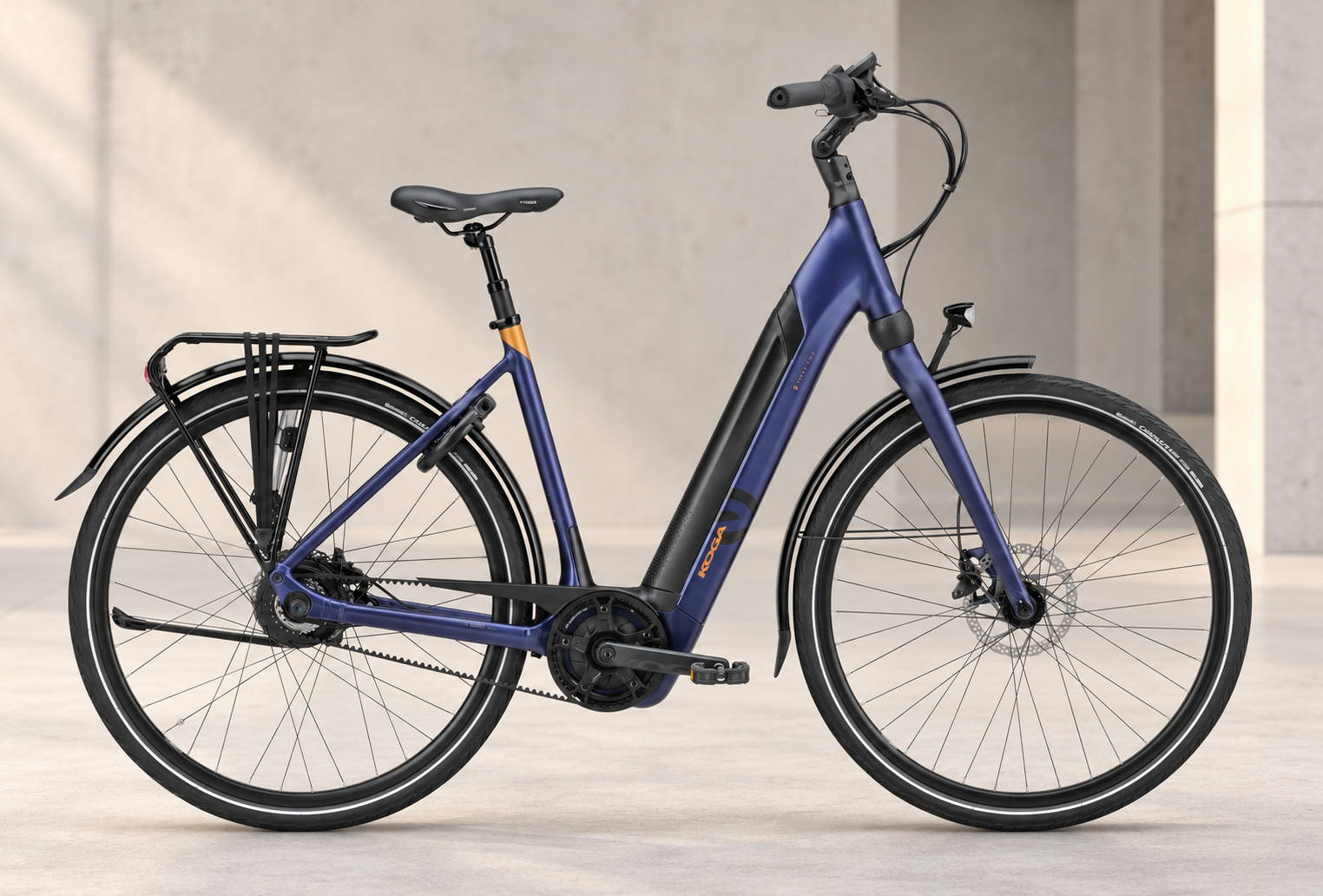
The current lineup clearly reflects the brand's direction. The E-F3 is lightweight and sporty, with a belt drive and continuously variable hub, designed for commutes and long rides. The E-Nova sits at the other end of the spectrum: wide tires , suspension, a more upright riding position—comfort takes precedence over sportiness. The E-Xite is the e-SUV of the lineup, with a powerful mid-drive motor and a large battery.
For me, the most interesting feature of these models is neither the torque nor the battery capacity, but the choice of components. A belt paired with a continuously variable hub requires little maintenance, but its parts are more expensive than a traditional chain with a derailleur. That’s not a flaw. It’s something to consider before you buy, rather than after. Can’t decide between the two drivetrains? Read our comparison Chain or belt: which system should you choose.
Are you looking for a Koga?
Check out our refurbished Koga e-bikes, inspected by professional mechanics and backed by a 1-year warranty.
See the KogaWhat a Beautiful Setting Doesn't Tell You
A well-maintained Koga often looks better in a store window than it does on the road. The paint and frame age slowly, but the drivetrain and electronics age much more quickly. A bike that looks “ new ” after six years may have a chain stretched beyond its limit, a cassette with teeth worn down to hooks, brake pads that are worn out, and bearings that are starting to develop play.
It’s with the battery that the gap between appearance and reality is the widest. You can’t see the loss of capacity. Either you measure it, or you discover it after three weeks of use. A 500-Wh battery that now only delivers 340 Wh isn’t broken, but it gives you a third less range than the advertising suggests. To recognize these signs, check out our guide on electric bike battery issues.
That leaves the question of replacement parts. For an older electric Koga, the issue isn’t whether the motor works today, but whether it will still be possible to diagnose and repair it three years from now. Some systems that are no longer in production can no longer be diagnosed. You then end up with a bike that can only be repaired by taking parts from another bike. The most common symptoms are detailed in our article on how to detect problems with your electric bike.
How to Evaluate a Used Koga: A Practical Guide
Start with the nameplate and the model year. Next, check the powertrain, the display, and the battery type. Only once you know these three details does it make sense to talk about price. Here’s what else you need to check:
- The battery's measured capacity—not just the number of Wh listed on the label.
- The original charger and keys, including the spare key for the battery holder.
- The availability of the motor, the screen, and a replacement battery.
- The condition of the built-in cables, the battery mount, and the contact points.
- Wear and tear on the chain or belt, the cassette or hub, the brakes, and the tires.
- Play in the headset, bottom bracket, rear triangle, and seat post clamp.
The Test Drive
During the test ride, don’t ride exclusively in the highest assistance mode. Start from a cold engine, pull away from a stop, cycle through all the modes, and ride for a while without assistance. A system that hesitates at low cadences or loses traction on cobblestones or uneven roads can only be caught out this way.
In my opinion, this is exactly where a bike inspected by professionals makes a difference. A documented battery diagnostic test, performed under load, is the only part of the evaluation that you, as a buyer, cannot do yourself. With an electric bike refurbished, this test—combined with the replacement of wear-and-tear parts and the warranty—is what separates a gamble from a well-thought-out purchase. You’re no longer just buying a brand name, but a professionally tested combination of frame, motor, and battery—often in a price range that would otherwise exceed your budget at new. To learn how this inspection is conducted, check out our reconditioning process.
Refurbished electric city bikes
For your daily commutes, whether on the road or on cobblestones: check out our selection of city bikes, all inspected by our mechanics.
View city bikesConclusion: Buy the book, not the name
An older Koga can be a great deal. The frame is often the sturdiest part of the bike. But on an electric model, it’s the battery, the motor, and the availability of parts that determine whether you’ll be able to keep riding it for years to come. So evaluate the frame and the motor separately, ask for the measured battery capacity, and make sure the system can still be serviced.
"You can't tell a good bike by the name on the frame, but by what's underneath it."
Frequently asked questions
Is Koga Miyata a good brand?
What is the difference between Koga Miyata and KOGA?
How do you check the battery on a used Koga?
Which Koga should you choose for your commute?
Is a Koga refurbished reliable?
About the Author: Jos Mans
Jos is both a writer and a cyclist—and more often than not, he does both at the same time. With thousands of kilometers under his belt and just as many words on paper, he combines his two great passions: being on the road and telling stories.