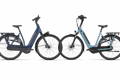
What is the difference between a Gazelle C7 and a Gazelle C8?

Some questions seem simple but aren’t. Seven or eight gears: that’s the most obvious calculation. More is better, right? Yet if there’s one thing I’ve learned after riding thousands of miles on very different bikes, it’s that specs tell you what a bike can do, while how it handles on the road tells you what a bike is. The Gazelle C7 and C8 aren’t fixed models that can be directly compared. They’re configurations found throughout the Gazelle lineup: Orange, Paris, Grenoble, Ultimate. That’s why the difference deserves an honest explanation.

Written by: Jos Mans | April 13, 2026 | Reading time: 5minutes

About the author: Jos Mans

Jos is a writer and cyclist, most often both at the same time. With thousands of miles under his belt and just as many words on paper, he combines his two great passions: being on the move and telling stories.

A Gazelle C7 and a Gazelle C8

Key findings

  1. The Shimano Nexus 8 offers a gear range of 307%, compared to 244% for the Nexus 7—a difference that’s barely noticeable in the city, but becomes significant when riding into the wind, on bridges, and over long distances
  2. C7 and C8 are configurations, not fixed models: a Grenoble C7+ may be better equipped than an entry-level C8 elsewhere in the lineup
  3. When buying a refurbished item, the condition of the battery and motor, as well as the maintenance history, are just as important as the price tag

Specifications for the C7 and C8

FeaturesGazelle Paris C7Gazelle Orange C8
EngineBosch Active Line Plus, 50 NmBosch Performance Line, 65 Nm
Battery400 Wh (500 Wh option)500 Wh
Hub (gears)Shimano Nexus 7 – 244% gear rangeShimano Nexus 8 – 307% gear range
BrakesTektro hydraulic brakesShimano hydraulic brakes
Weightapprox. 27 kgapprox. 28 kg
ANWB Note7.8 (Paris C7 HMB, 2021)Grenoble C8: 8.3 (2026)
Ideal useCity, flat terrain, short distancesVersatile, long distances, wind

What C7 and C8 Actually Mean

The "C" in Gazelle model names stands for comfort. Since 2014, Gazelle has standardized this naming convention: the letter indicates the segment (comfort), and the number indicates the number of gears in the hub. It is therefore a technical designation.

This also means that the C7 and C8 are not separate models. A Grenoble C7+ HMB won the 2019 ANWB test with a score of 8.4. A Paris C7 HMB scored 7.8 in 2021. The idea that the C7 is the entry-level model and the C8 is the high-end model is incorrect. What matters is the combination of the hub, motor, battery, brakes, and frame.

The main technical difference lies in the Shimano hub:

  • Nexus 7: total range of 244%
  • Nexus 8: 307%, with smaller variations in speed

This gradual approach is essential: it’s not just about the range, but also about the precision with which the pace is adjusted.

The difference you feel — and when

In the city, on flat terrain, and for short trips, the difference is negligible. Seven gears are more than enough.
But as soon as conditions change—headwinds, bridges, longer routes—the Nexus 7 can sometimes feel limited: one speed is too high, the next too low. The Nexus 8 almost always offers a suitable middle ground.

For occasional use, it doesn't matter much. But with daily use, the difference adds up and becomes significant.

On e-bikes with a less powerful motor, a wider range is even more useful: it allows for a better balance of effort between the rider and the motor.

Refurbished Gazelles: Why the Name Can Be Misleading

In the secondhand or refurbished market, you can find models from different generations. Relying solely on the model number is a mistake.

A well-maintained older Grenoble C7+ may be a better choice than a newer but poorly maintained C8. The model family (Orange, Paris, Grenoble, Ultimate) often tells you more than the model number.

Shimano recommends servicing the Nexus 8 every two years or every 5,000 km under heavy use. Without maintenance, the hub will lose its smoothness.

When making a purchase, it’s especially important to check:

  • remaining battery capacity
  • The Year of the Engine
  • gear shifting behavior
  • the condition of the brakes

What choice should I make?

  • C7: ideal for city driving, short trips, and flat terrain — simple, reliable, and more affordable
  • C8: Best for long distances, windy conditions, and hilly terrain—offers greater flexibility and comfort over the long term

In a nutshell:

The C7 is a good bike. For most everyday riders, the C8 is a better bike—not because of some “magical” extra gear, but because it’s a more balanced package.

But it all depends on the overall condition: a neglected C8 will always be worth less than a well-maintained C7.

The best Gazelle bike isn't necessarily the newest, the most expensive, or the one with the highest model number—it's the one where all the components work together seamlessly.


FAQ

What is the difference between a Gazelle C7 and a C8?

The C7 uses a Nexus 7 hub (244%), while the C8 uses a Nexus 8 hub (307%) with finer gear ratios. The difference is negligible in city riding, but noticeable on long distances or when riding into the wind.

Is a C8 always better than a C7?

No. The overall condition (battery, engine, maintenance) is more important than the configuration.

How do you check a refurbished bike refurbished

Check the battery, motor, hub, and brakes.

Is the difference noticeable in everyday life?

Yes, especially on long or varied routes.

Do you still have questions?

Contact us by email: support@upway.shop