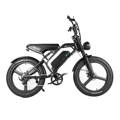
Is it mandatory to wear a helmet when riding a fatbike?

A faint hum around the corner, tires on the asphalt, a thirteen-year-old without a helmet crossing an intersection. Three years ago, the fatbike was a niche product. Today, it has become a national debate on safety, complete with letters to Parliament, accident statistics, and a minister promising new regulations. The question everyone is asking seems simple: should you wear a helmet when riding a fatbike? The short answer is no—not yet. But the long answer is more complex.

Written by: Jos Mans | April 3, 2026 | Reading time: 5minutes

About the author: Jos Mans

Jos is a writer and cyclist, most often both at the same time. With thousands of miles under his belt and just as many words on paper, he combines his two great passions: being on the move and telling stories.

fatbike

Key findings

  1. No helmet requirement yet. As of this writing—April 1, 2026—there is no requirement to wear a helmet when riding a legal fatbike in the Netherlands. Legally, it is simply an electric bike with large tires, as long as it meets the standard requirements for e-bikes.
  2. The government is planning to make it mandatory for riders up to age 18. This applies to all electric bicycles, including fatbikes. Implementation is planned for 2027.
  3. Unrestricted = illegal. A fatbike equipped with a throttle that allows you to ride without pedaling at speeds exceeding 6 km/h is legally classified as a moped. In this case, a helmet is required, as well as insurance and a minimum age of 16.

What the law says today

The "fatbike" does not legally exist as a separate category. A fatbike that meets the criteria of a standard e-bike—pedal assistance, a maximum speed of 25 km/h, and a motor with a maximum power of 250 watts—is considered by law to be an electric bicycle. And for an e-bike, there is no requirement for a helmet, license, registration, or minimum age.

The ministry has repeatedly considered the possibility of regulating fatbikes separately, for example based on weight or motor torque. The consulting firms DTV and Goudappel concluded that these characteristics overlap too much with those of other e-bikes and are too easy to circumvent. This explains why the government is now focusing on all e-bikes used by minors, rather than just fatbikes.

The numbers behind the debate

The political pressure stems from accident statistics. VeiligheidNL reports that emergency room visits related to e-bike accidents doubled between 2020 and 2024. Among young people aged 12 to 17, serious injuries increased by 491%, and head injuries by 522%.

Specifically for fatbikes:

  • 75 visits to the emergency room in 2023
  • 301 in 2024
  • More than half involved young people aged 12 to 18

SWOV, a scientific institute specializing in road safety, shows that wearing a helmet reduces the risk of serious head injuries by about 60% and the risk of fatal injuries by 71%.

The industry—RAI Vereniging, BOVAG, and Fietsersbond—believes that stricter controls on illegal imports and engine tampering would be more effective than a blanket helmet mandate. Both arguments are valid, but they are not mutually exclusive: a helmet provides immediate protection, whereas enforcing laws against engine tampering takes time.

Legal versus Unrestrained

This distinction is crucial. A legal fatbike is an e-bike. An unregulated fatbike—one equipped with a throttle, modified software, or a motor that allows it to travel without pedaling at speeds exceeding 6 km/h—is legally classified as a moped.

In that case, everything changes:

  • helmet requirement
  • insurance requirement
  • minimum age of 16
  • Class AM license

On the road, this difference is hard to spot, which makes inspections difficult.

Many of the problems stem from fatbikes imported through unregulated channels—cheap models that are sometimes already modified at the factory. At Upway, every refurbished fatbike refurbished a comprehensive technical inspection: the motor is set to factory specifications, the software is verified, and assistance is limited to 25 km/h in accordance with the law. A refurbished fatbikeUpway therefore, by definition, legal: no throttle, no gray areas, and up to 60% cheaper than a new one.

What's happening

The government plans to introduce a helmet requirement for all e-bikes for riders up to age 18. An Ipsos survey conducted in January 2026 shows that 79% of parents and 53% of young people support this measure.

Objective:

  • draft regulations: summer 2026
  • Effective date: 2027

Criticism from the industry is valid: the measure also affects young people riding legal e-bikes, whereas the real problem lies in illegal imports and dangerous behavior. But the rationale is clear and logical: if a measure can prevent 60% of serious head injuries, the question may not be whether it is restrictive, but why it shouldn’t be implemented.
In short: no, there is not yet a helmet requirement for fatbikes, but yes, a regulation to that effect—for riders under 18—is being seriously considered.

FAQ

Will helmets be required when riding a fatbike in 2026?

No. As of April 1, 2026, there is no helmet requirement for a street-legal fatbike. For an unrestricted fatbike with a throttle, however, there is—it is legally classified as a moped. The government is planning to introduce a helmet requirement for riders under 18, scheduled to take effect in 2027.

At what age can you start riding a fatbike?

There is no minimum age requirement for a street-legal fatbike. If it is classified as a moped, the minimum age is 16, and a Class AM license is required.

When is a fatbike illegal?

As soon as it can travel without pedaling at a speed exceeding 6 km/h or the motor assistance exceeds 25 km/h. In this case, the police consider it a moped.

Why choose a refurbished fatbike refurbished Upway

Every fatbike is inspected to verify its factory settings, software, and legal assistance limits. You’ll always ride legally, save up to 60%, and avoid unpleasant surprises during a traffic stop.

Do you still have questions?

Contact us by email: support@upway.shop