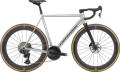
Cannondale CAAD Review

Cannondale began building aluminum bikes in 1983, long before the material was taken seriously in the peloton. The name CAAD—Cannondale Advanced Aluminum Design—was introduced in 1996 and has, over the years, achieved a status that no other aluminum platform has managed to match. Gilberto Simoni won the Giro in 2003 on a CAAD7. Damiano Cunego repeated the feat in 2004 on a CAAD8. Since then, no overall victory in a Grand Tour has been achieved on an aluminum bike. This explains why Cannondale still treats aluminum differently from most brands today. For the refurbished market, this has direct consequences: a well-inspected 2018 CAAD12 has little to envy in many entry-level carbon road bikes from 2026, at a fraction of the price.

Written by: Jos Mans | May 8, 2026 | Reading time: 5minutes

About the author: Jos Mans

Jos is a writer and cyclist, most often both at the same time. With thousands of miles under his belt and just as many words on paper, he combines his two great passions: being on the move and telling stories.

Cannondale CAAD

Key findings

  1. In my opinion, the CAAD12 is the best secondhand option in the entire lineup: it’s lightweight, modern enough to feature disc brakes, and offers a level of value for money that you simply can’t find in new anymore.
  2. CAAD models vary significantly from one generation to the next. A CAAD Optimo and a CAAD13 share the same name, but they are fundamentally different bikes; confusing the two means you’ll end up buying either too much bike or not enough.
  3. Aluminum ages in a more predictable way than carbon. On every older CAAD, you need to check the welds, the BB30 bottom bracket, and the brake tracks; after that, you often end up with a bike that’s superior to an equivalent carbon model in the same price range.

CAAD Models at a Glance

ModelYearsFrameBrakesCharacter
CAAD82012–2016SmartForm AluminumSkatesAccessible, sporty
CAAD102011–2016High-quality aluminumSkatesStraightforward, lively, classic
CAAD122016–2019SmartForm AluminumBlades and discLightweight, race-oriented
CAAD132020–2023SmartForm AluminumDiscAero, more comfortable
CAAD OptimocontinuousSmartForm C2Skates / DiscEntry-level sports model
CAAD142024–presentSmartForm C1 PremiumDiscPremium aluminum

CAAD as a racing platform

What sets the CAAD apart from other aluminum road bikes is that Cannondale has never treated aluminum as an entry-level material. Lightweight tubes, hydroforming, optimized welds, and race-oriented geometry are standard features, even on models where this wasn’t a given. A carbon fork is part of the package, as is a sporty—and sometimes downright aggressive—riding position.

The result is a bike that stands out from the very first few meters. Precise handling, an immediate sense of acceleration, and a low margin for error. Riders coming from an endurance bike like the Cannondale Synapse will be surprised by the difference. Those coming from carbon bikes may sometimes miss the vibration damping, but they’ll gain a responsiveness that has often been lost in new carbon frames with internal cable routing and aerodynamic profiles.

The CAAD isn't for everyone. But for those it's suited to—competitive cyclists, criterium racers, and fans of fast group rides—it's often the best option on the used market.

Which CAAD models are really worth buying refurbished

Cannondale CAAD

Not all CAADs are equally appealing on the used market. The core of the relevant lineup is limited to just a few models.

Cannondale CAAD12

For me, the CAAD12 (2016–2019) strikes the perfect balance. Models from recent years are equipped with disc brakes and accommodate tires ; the earlier versions retain that pure CAAD feel that so many cycling enthusiasts rave about. With a Shimano 105 or Ultegra groupset, it’s a bike built to last for years.

Cannondale CAAD13

The CAAD13 (2020–2023) is more modern and comfortable. It features lowered rear dropouts, aerodynamic design elements, standard disc brakes, and clearance for tires . Those who find the CAAD12 too radical or who want more versatility for long rides will find this model to be a better compromise. It’s a bit less sought-after by purists, so it’s sometimes more affordable.

Cannondale CAAD10

The CAAD10 (2011–2016) is a cult classic. It features a classic design, rim brakes, and extremely direct handling. For fans of traditional aluminum road bikes and criterium racers, it remains the gold standard. However, you should be mindful of its age and wear and tear.

Cannondale CAAD Optimo

The CAAD Optimo tells a different story. It’s Cannondale’s entry-level model: sporty, with the CAAD DNA, but neither the components nor the frame are comparable to a CAAD12. It’s an excellent first road bike, but not the one you’d ride to catch up with a fast group. Anyone who confuses it with a CAAD12 isn’t getting enough for their money.

To be thorough: the CAAD8 is an older, more affordable model, while the CAAD14 is the new premium model launched in 2024—both are still relatively rare on the refurbished market, for different reasons.

CAAD or SuperSix EVO: aluminum or carbon?

The question of whether it’s better to buy a CAAD or a Cannondale SuperSix EVO comes up often. The answer is less obvious than marketing trends might suggest.

The SuperSix EVO is Cannondale’s carbon road bike. It’s lighter, more refined, and more comfortable on rough roads. For racing and long distances, it’s objectively the best bike. But this difference is more apparent in the new price new on the used market. A refurbished CAAD12 refurbished with Ultegra often costs less than a ten-year-old SuperSix with the same groupset, while offering a more responsive ride.

Carbon frames also require more careful consideration when buying refurbished. Hidden damage, previous repairs, aging resin—in this regard, an aluminum frame offers greater transparency. For your first real road bike, or as a second bike for bad weather, I’d say: go with the CAAD.

What I check when buying a used CAAD

You don't buy a CAAD just for the name. Four factors are essential.

The framework

You should check the welds around the head tube, bottom bracket shell, and seat tube. Cannondale used the BB30 or BB30A standards on many older models; play or creaking are known issues. This isn’t necessarily a major problem, but it’s best to be aware of it before buying.

The transmission

Shimano 105 groupsets and higher are common on CAAD models. Wear on the chain, cassette, and chainrings is normal on a bike that has been ridden, but it should be properly assessed. When buying refurbished bike, this has often already been done: check the inspection report.

The wheels

On models with rim brakes, the condition of the braking surfaces is critical. Rims that are too thin or worn out will eventually require wheel replacement.

The clearance between tires brakes

Older CAAD models often have limited clearance (25 or 28 mm). Those who want to ride with 30 mm tires should consider the CAAD13 or CAAD14 instead. This isn’t a minor detail: it directly affects how the bike can be used.

FAQ

What is the best used CAAD?

For most cyclists, the CAAD12 is the way to go. It’s modern enough with its disc-brake versions, light enough to keep up on a fast group ride, and very attractively priced. Those looking for more comfort will be better served by the CAAD13; those seeking a classic, sporty, and responsive bike will choose the CAAD10.

What is the difference between a CAAD Optimo and a CAAD12?

Both bear the CAAD name, but they are fundamentally different bikes. The Optimo is Cannondale’s entry-level model, featuring SmartForm C2 aluminum and simpler components. The CAAD12 is a step up: a lighter frame, race-oriented geometry, and higher-end drivetrains. The price difference new significant.

Is a CAAD a good choice for someone just starting out in road cycling?

An Optimo or CAAD8, yes. The CAAD10 and CAAD12 have a sporty geometry that might be a bit challenging for a beginner. It’s better to start with a more beginner-friendly model and then move up later.

How can you tell if a CAAD frame is still in good condition?

Any refurbished purchase refurbished include a technical inspection that checks the welds, bottom bracket, headset, and wheels. Ask for the report. A reputable seller will provide it without hesitation.

Do you still have questions?

Contact us by email: support@upway.shop